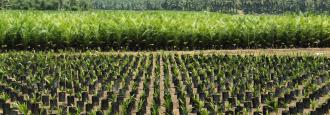
The world is losing 11 football (soccer) fields of tropical primary forest every minute; much of it is the result of clearing for farms, pastures and tree plantations.
As a major buyer of commodities largely responsible for fueling deforestation — such as palm oil, cocoa, coffee, soy, cattle and timber — the European Union has both a responsibility and an opportunity to help shift global markets toward more sustainable supply chains. The landmark EU Deforestation Regulation (EUDR), adopted in 2023, requires businesses to demonstrate that the products they sell or export to the EU do not come from land that was recently deforested or degraded.
The EUDR is a key step in fighting back against deforestation and supporting national forest protection policies. Yet despite its promise, the regulation has faced delays and pushback, threatening its timely implementation.
Just weeks before the EUDR was to go into force on Dec. 30, 2025, the European Parliament voted to delay application until Dec. 30, 2026 for large corporations and until June 30, 2027 for small businesses. Along with the delay, new amendments weakened the regulation by simplifying requirements for certain businesses to show proof of deforestation-free products; and removed printed products, such as books and publications, from the regulation's scope.
At a time when forests are increasingly under threat, it’s more urgent than ever to understand the regulation and ensure its full implementation. Here, we dive deeply into the legislation's details and potential impacts.
What Is the EUDR?
The EUDR is a landmark law that came into force in June 2023. Its goal is to ensure that certain products sold in or exported to the EU do not come from land that was deforested or degraded after Dec. 31, 2020. The regulation is designed to prevent EU consumer demand from driving further forest loss or damage, while also reducing the region’s contribution to greenhouse gas emissions and global biodiversity decline.
The EUDR covers timber and six key agricultural commodities: cattle, cocoa, coffee, oil palm, rubber and soy, as well as products made from them such as beef, furniture and chocolate (printed products such as books and newspapers were removed from the scope of the regulation in December 2025). To be sold in or exported from the EU market, these products must meet the following three conditions:
- Products are deforestation-free.
- Products are produced in compliance with the relevant laws of the country of origin.
- Products are covered by a due diligence statement, showing that the company has checked the origin and ensured the products meet EUDR requirements.
This means businesses must demonstrate that any EUDR-covered commodities were not produced on land that was deforested nor did they contribute to forest degradation after the Dec. 31, 2020 cutoff date. Although the regulation is legally in place, companies are not required to start complying until Dec. 30, 2026, for large corporations and June 30, 2027, for small enterprises.
Why Is the EUDR important?
The EUDR offers a major opportunity for the EU to reduce its role in global deforestation and biodiversity loss, as well as help create deforestation-free supply chains. It supports the commitment made by the 144 countries that signed the Glasgow Leaders’ Declaration in 2021 to halt and reverse forest loss and land degradation by 2030. It can also serve as a model for other major consumer markets looking to lower their environmental footprints.
Since 2014, the EU has been the second-largest importer of goods linked to tropical deforestation after China. In 2017 alone, it accounted for 16% of global deforestation tied to international trade — equal to 203,000 hectares of forest.
More recently, in 2025, the EU was among the world’s top five importers of the six agricultural commodities covered by the EUDR and the largest importer of cocoa beans, coffee, rubber and soy worldwide. Globally, 34% of tree cover loss resulted in deforestation between 2001 and 2025, with agricultural commodity production accounting for roughly 94% of this deforestation.
Among all the agricultural products the EU buys, beef, cocoa and palm oil were linked to the most deforestation in the countries they came from. In fact, out of 160 agricultural commodities imported by the EU, just six — beef, palm oil, soy, cocoa, coffee and rubber, as covered by the EUDR — made up 58% of the estimated forest loss tied to EU imports.
By reducing the EU’s forest-loss footprint and tackling deforestation risks in its supply chains, the EUDR could help reverse deforestation worldwide. In 2025, the world lost 4.3 million hectares of tropical primary forests, an area roughly the size of Denmark. Despite a notable decline from a record high in 2024 following a year of extreme fires, the world is still losing an equivalent of 11 football (soccer) fields every minute. Agricultural expansion is the leading driver of tree cover loss across the tropics.
What Challenges and Setbacks Has the EUDR Faced?
The rollout of the EUDR has faced repeated delays. In December 2024, the EU postponed the start of EUDR compliance by 12 months to give companies more time to prepare. By September 2025, the EU Commission signaled another potential one-year delay, citing problems with the EUDR platform companies must use to submit due diligence statements.
The EU Commission later proposed simplifying requirements for micro and small primary operators, as well as downstream businesses, delaying the application date for those companies.
Then, on Dec. 17, the European Parliament formally approved a one-year delay: Large companies would not be held accountable until a Dec. 30, 2026 start date, while small companies with less than 50 employees and earning less than 10 million euros ($11.7 million) in sales would not need to comply until June 30, 2027.

Challenges also came from new proposals which called on the EU Commission to revise its benchmarking classification system designed to help EU businesses and enforcement authorities conduct due diligence and enforce compliance. The risk levels indicate the percentage of checks on shipments, with greater scrutiny given to higher-risk countries.
Some countries have suggested adding a “no-risk” category to exempt certain countries from due diligence requirements; another suggestion proposed removing the system altogether. But changes like these could create loopholes and ultimately weaken the regulation’s effectiveness. The European Parliament already rejected a similar idea in 2024 for that very reason.
The EUDR was initially agreed upon following a lengthy negotiation between EU institutions and member states, as well as impact assessments and extensive consultations. Derailing its implementation penalizes producer countries and companies that have already invested in compliance, and it would create confusion and uncertainty in the EU market. The regulation may not be perfect, but it’s a necessary step toward deforestation-free supply chains. Many companies have already shown that EUDR compliance is possible, and several have urged the EU to uphold the legal text and stick to implementation timeline.
Since adoption, the EUDR has faced criticism from both inside and outside the EU. Most concerns focus on cost and complexity of compliance, as well as fairness, particularly for smallholder farmers. In response, the European Commission, EU member states and other development institutions have ramped up investment in EUDR preparedness by issuing resources and guidance, with a particular emphasis on preventing smallholder exclusion from the EU market.
What Counts as Deforestation and Degradation Under the EUDR?
| The regulation's definition of a forest largely follows the UN Food and Agriculture Organization (FAO) which defines it as land larger than 0.5 hectares with trees taller than 5 meters and a canopy cover of at least 10% that is not primarily used for farming or urban development. |
Under the EUDR, deforestation refers to clearing forest to make way for agriculture. The key factor is the conversion of land that was forest in 2020 into farmland — such as pastures or soy plantations. It’s a complete land-use change: the forest is no longer a forest.
If that forest is cleared — whether by people or natural events like fire — and then converted into farmland, such as pastures for raising cattle or fields for soy or palm oil, it is considered deforestation.
- However, if a forest is cleared, for example by fire (whether from human activity or natural causes) and is not used to produce any of the six EUDR-covered agricultural commodities, it is not considered deforestation under the regulations.
- Forests used for wood production are not considered deforestation unless they’re also used for agriculture, for example, cattle grazing under the tree canopy.
The EUDR also covers degradation. Land that was forest in 2020 can be used for wood production and remain classified as a forest, even if it’s temporarily unstocked, according to EUDR definitions. A forest used for wood production is not considered degraded unless there's a specific structural change, such as:
- Converting primary forest (native, untouched forest) into other wooded land (trees have 5%-10% canopy cover) or into plantation or planted forest.
- Converting naturally regenerating forest (which has largely grown back on its own) into other wooded land used or plantation forest.
Who Does the EUDR Affect?
The EUDR affects any company that imports, produces or exports specific products, and their derivatives, to or from the EU market. This includes operators (those placing products on the market or exporting them from the market) and traders (those distributing and selling products).
It applies to companies based in the EU and internationally, and to businesses of all sizes, from micro and small enterprises to large corporations. However, larger businesses face stricter reporting requirements than smaller ones.
The EUDR spans multiple sectors, from food and beverage (such as companies sourcing cocoa and coffee) to wooden furniture to the healthcare industry (products such as latex gloves).
How Are Countries and Companies Preparing for the EUDR?
Under the EUDR, companies must prove that products linked to deforestation or degradation after Dec. 31, 2020, are not entering the EU market. This requires a due diligence process: collecting supply chain information (including geolocation), assessing the risk of deforestation and taking steps to eliminate any identified risk before the product can be put on the market.
Country-level efforts
Many producer countries are already taking concrete steps to prepare for the EUDR, from adopting national plans to developing traceability systems and improving data transparency. For example, Indonesia, Ghana and Vietnam are investing in government-led efforts to make information available to companies that must comply with the regulation. Delaying enforcement or altering the regulation’s scope could undermine these leading producer countries.
Vietnam stands out as a strong example of how the EUDR is reinforcing national policies to combat deforestation. As a top exporter of rubber and coffee, the country has shifted its focus from illegal logging to broader deforestation risks in agriculture since the regulation’s introduction. In 2023, the Ministry of Agriculture and Rural Development adopted a national action plan prioritizing sustainable agricultural transformation. The following year, it launched a traceability system for coffee farms, piloting geospatial verification (such as satellite images) in key producing provinces. Developed through public-private collaboration, the system cross-references land-use maps and cadastral data to ensure EUDR compliance. Plans are also underway to expand it to rubber and cocoa.
Vietnam’s progress shows how the regulation can act as a catalyst for stronger policy alignment between global market demands and local sustainability goals.
EU member states are also preparing by using satellite and aerial earth observation data, such as forest maps from 2020 (the EUDR cutoff year) to detect deforestation, alongside other monitoring solutions and tools to support compliant imports.
Private-sector efforts
Companies across supply chains are ramping up EUDR preparations, sparking a wave of innovation in monitoring and traceability. Many are developing satellite-based systems to verify deforestation-free sourcing, training smallholder farmers to meet EUDR requirements and partnering with governments and NGOs to improve data sharing and risk assessment.
For example, Unilever and Meridia are working together to map smallholder farmers in Indonesia, making it possible to trace palm oil from plantation to mill. The Global Platform for Sustainable Natural Rubber (GPSNR) has created a system to help companies follow sustainability practices and demonstrate EUDR compliance. Open-source platforms like WRI’s Global Forest Watch are also supporting companies in verifying supply chains.
These efforts from governments, companies and EU countries show how the EUDR is already driving unprecedented action — transforming compliance from a burden into an opportunity to build more responsible and transparent supply chains. The challenge now is scaling these solutions across all commodities and regions.
What's Next for the EUDR?
In the latest EUDR simplification review, the European Commission published a formal report analyzing the compliance cost reduction by the simplified measures, alongside updated FAQs and guidance on how the rules should be applied. The review also includes a draft Delegated Act to adjust the product scope; notably, the Commission proposes removing leather and retreaded tires from the regulation while potentially adding instant coffee and certain palm oil derivatives. This draft is now open for public consultation until June 1, 2026. The EUDR represents a major milestone in the fight against commodity-driven deforestation.
Through this review, the Commission also made clear that its goal is to help companies implement the simplified rules before the December 30 deadline, rather than introduce further legislative changes to the EUDR's core text, ensuring regulatory certainty.
The Commission is also updating the user friendliness of the EUDR Information System that companies use to submit their due diligence statements and incorporating the December amendments. Specifically, these updates include a simplified form for small businesses, updated automated interfaces (APIs) and a contingency plan to ensure reliability as the December deadline approaches.
What's the Path to Full EUDR Implementation?
The EUDR represents a major milestone in the fight against commodity-driven deforestation, and its effectiveness depends on maintaining its ambition without dilution or delay. The EU must stand firm in its commitment to not reopen the legal text and continue its support to businesses, governments and national enforcement bodies as the implementation deadline nears.
With the ground rules in place, the focus shifts squarely to implementation. Companies need to move quickly and use the remaining months to continue aligning their compliance systems and supply chains. The EUDR is not only a necessary response to the crisis of forest loss, but also a vital tool to support and complement producer country efforts to halt deforestation by 2030.
NOTE: This blog was originally published as an Explainer in WRI Insights. To access this post on WRI Insights, follow this link.